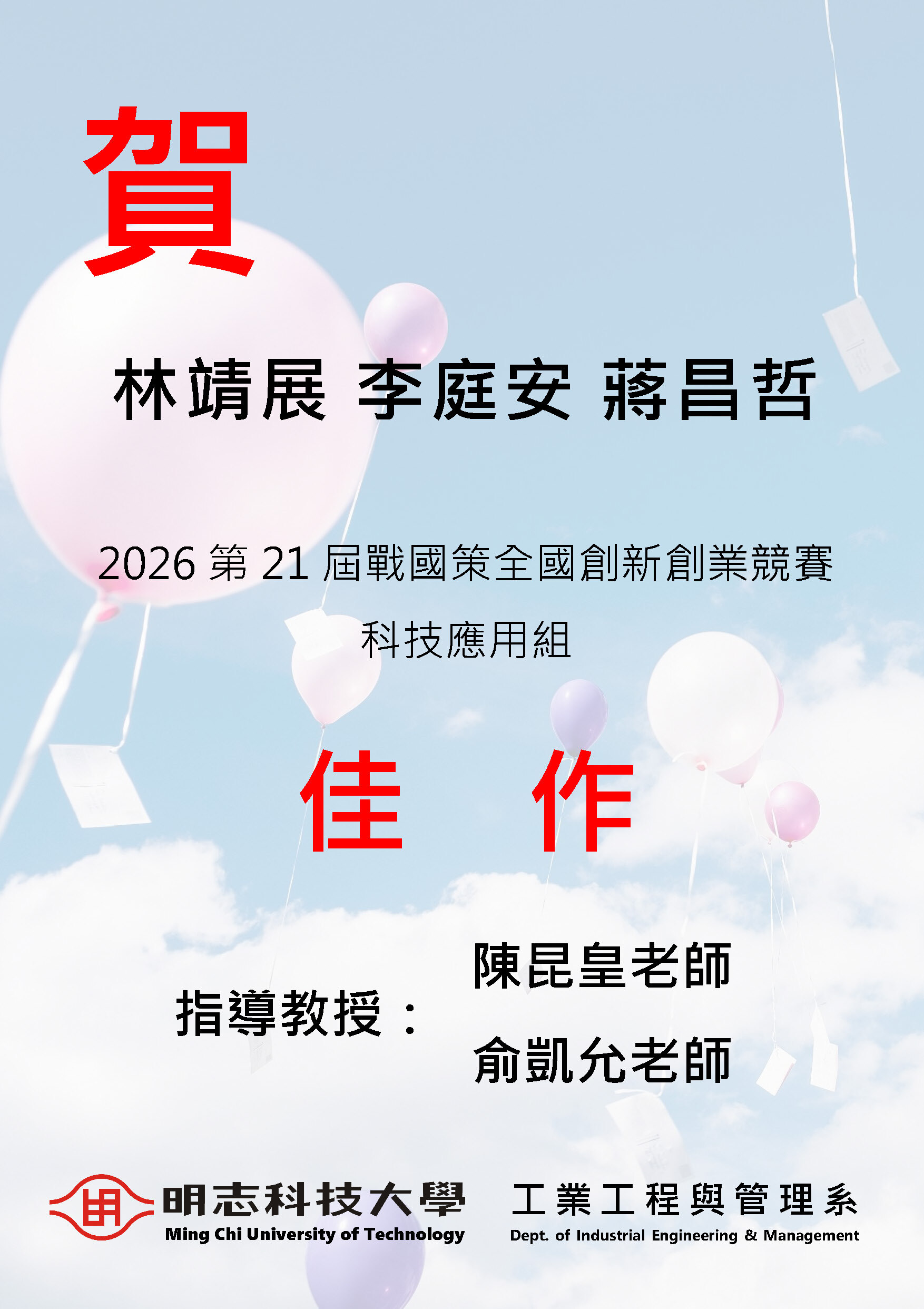
恭賀!工管系陳昆皇、俞凱允老師指導林靖展、李庭安、蔣昌哲同學,參加「2026 第 21 屆戰國策全國創新創業競賽科技應用組」,榮獲佳作
工管系攜手工智學程 榮獲2026第21屆戰國策全國創新創業競賽科技應用組佳作
競賽說明
「第21屆戰國策全國創新創業競賽」以培育青年創新創業精神及促進產學合作為宗旨,鼓勵學生結合科技創新、商業模式及市場需求,提出具創新性與實務應用價值之創業構想,並透過競賽培養跨域整合、創新思維及實踐能力,是國內具代表性的創新創業競賽之一。
本屆競賽共吸引全國269組團隊參賽,涵蓋「科技應用組」、「創新服務組」及「新創企業組」三大類別,競賽領域包括人工智慧、物聯網、綠色科技、資通訊、生技醫療、金融科技、數位服務、智慧商務及地方創生等。競賽採初賽書面審查及決賽簡報評選兩階段方式進行,由專家評審委員針對創新性、技術可行性、商業模式、市場需求及團隊執行能力進行綜合評選。
本屆共有29組團隊晉級決賽,決賽入圍率約10.8%,顯示參賽團隊須具備完整的創新構想、技術實力、商業可行性及簡報表達能力,方能自眾多隊伍中脫穎而出,競爭相當激烈。此外,競賽亦提供創業育成、創業輔導及投資交流等資源,鼓勵優秀團隊持續推動創新成果商品化與創業發展。
獲獎說明
本次由工管系與工智學程學生跨域合作,以研究計畫「顧顏美學—側顱X光自動點位標註系統」****參加「第21屆戰國策全國創新創業競賽」,經初賽書面審查、專業評選及決賽簡報答詢等階段,最終榮獲******科技應用組佳作**,其研究之技術創新性、臨床應用價值及未來發展潛力獲得評審肯定,充分展現跨領域研究與創新實踐成果。
獲獎名單
科技應用組 佳作
- 林靖展、李庭安、蔣昌哲同學(工管理系與工智學程跨域合作)
- 指導教授:陳昆皇、俞凱允老師
研究成果介紹
本研究聚焦於牙科、齒顎矯正及顱顏醫療領域,針對傳統側顱X光影像需仰賴專業人員進行人工辨識與標註解剖特徵點之流程,導入人工智慧影像辨識技術,建置側顱X光自動點位標註系統。系統可快速辨識顱顏骨骼與軟組織的重要定位點,降低人工標註所需時間,減少因操作經驗差異所造成的判讀誤差,提升顱顏分析作業的效率、一致性與客觀性。
本研究最大的特色在於整合人工智慧、醫學影像分析及顱顏美學評估技術,使原本高度仰賴專業人員經驗的側顱分析流程朝向智慧化、自動化及標準化發展。研究團隊除完成核心辨識模型與系統建置外,亦考量臨床操作流程、使用者需求及未來導入可行性,使研究成果兼具技術深度與實務應用價值。
研究期間,團隊完成文獻蒐集、醫學影像資料整理、人工智慧模型建立、系統測試、辨識結果驗證及應用模式規劃等工作,並持續與專業人員討論及修正系統內容,展現自主學習、跨域整合、團隊合作及問題解決能力。
獲獎意義
本次獲獎不僅代表「顧顏美學—側顱X光自動點位標註系統」研究於人工智慧醫療應用、臨床流程改善及創新發展等面向獲得專業評審肯定,也展現本校推動跨域學習、人工智慧應用及創新研究之具體成果。工管系全體師生恭賀獲獎同學與指導教授,並期許團隊持續精進研究成果,深化技術應用與臨床實務連結,為智慧醫療領域創造更多價值。
獲獎感言
本研究團隊表示,能於競爭激烈的全國性創新創業競賽中獲得肯定,首先感謝指導教授陳昆皇老師在研究方向、技術方法與實務應用上的悉心指導與支持,使團隊得以在人工智慧與醫療影像領域持續深化研究。
同時,也感謝工管系及工智學程提供跨域學習與研究資源,讓團隊能夠整合不同專業背景,將理論知識實際應用於醫療影像分析問題之解決。
團隊成員表示,本次研究歷程中歷經多次模型調整與系統優化,過程雖具挑戰,但也大幅提升跨領域協作、問題解決與實作能力。未來將持續精進人工智慧技術應用,並期望推動研究成果朝臨床實務與智慧醫療應用發展,創造更高之社會與產業價值。
Department of Industrial Engineering and Management Collaborates with the Bachelor Program in Industrial Artificial Intelligence to Receive the Honorable Mention Award in the Technology Application Division at the 2026 21st Warring States Strategy National Innovation and Entrepreneurship Competition
Competition Overview
The 2026 21st Warring States Strategy National Innovation and Entrepreneurship Competition aims to foster innovation and entrepreneurship among young talents while promoting industry–academia collaboration. The competition encourages students to integrate technological innovation, business models, and market demands into entrepreneurial proposals with both innovation and practical application value. Through the competition, participants develop interdisciplinary integration, innovative thinking, and practical implementation capabilities, making it one of Taiwan's representative national innovation and entrepreneurship competitions.
A total of 269 teams from across Taiwan participated in this year's competition, which featured three divisions: Technology Application Division, Innovative Service Division, and Startup Enterprise Division. The competition covered a wide range of fields, including artificial intelligence, the Internet of Things (IoT), green technology, information and communications technology (ICT), biotechnology and healthcare, financial technology (FinTech), digital services, smart commerce, and regional revitalization. The competition consisted of two stages: a preliminary document review followed by a final oral presentation. Projects were evaluated by a panel of experts based on innovation, technical feasibility, business model, market demand, and team execution capability.
A total of 29 teams advanced to the final round, representing a finalist rate of approximately 10.8%. The highly competitive selection process required participating teams to demonstrate comprehensive innovation, strong technical capability, commercial feasibility, and effective presentation skills to stand out among all entries. In addition to recognizing outstanding projects, the competition also provides startup incubation, entrepreneurship mentoring, and investment networking opportunities to support the commercialization of innovative research outcomes and entrepreneurial development.
Award Achievement
A collaborative team from the Department of Industrial Engineering and Management and the Bachelor Program in Industrial Artificial Intelligence participated in the 2026 21st Warring States Strategy National Innovation and Entrepreneurship Competition with the research project "GuYan Aesthetics – Automatic Landmark Annotation System for Lateral Cephalometric X-ray Images." After successfully completing the preliminary document review, professional evaluation, and final oral presentation, the team received the Honorable Mention Award in the Technology Application Division. The project was recognized by the judging committee for its technological innovation, clinical application value, and future development potential, demonstrating outstanding interdisciplinary research capability and innovative practice.
Award Recipients
Honorable Mention – Technology Application Division
- Lin Ching-Chan, Li Ting-An and Chiang Chang-Che
(A collaborative project between the Department of Industrial Engineering and Management and the Bachelor Program in Industrial Artificial Intelligence) - Advisor: Kun-Huang Chen and Calvin K.Yu Ph.D.
Research Highlights
This research focuses on the fields of dentistry, orthodontics, and craniofacial healthcare. To address the conventional workflow in which specialists manually identify and annotate anatomical landmarks on lateral cephalometric X-ray images, the research team developed an Automatic Landmark Annotation System for Lateral Cephalometric X-ray Images by incorporating artificial intelligence-based image recognition technology. The system can rapidly identify key craniofacial skeletal and soft tissue landmarks, significantly reducing manual annotation time, minimizing interpretation discrepancies caused by differences in clinical experience, and improving the efficiency, consistency, and objectivity of cephalometric analysis.
A key innovation of this research is the integration of artificial intelligence, medical image analysis, and craniofacial aesthetic evaluation into a unified intelligent system. By transforming the traditionally experience-dependent cephalometric analysis process into an automated, intelligent, and standardized workflow, the research demonstrates both technical innovation and practical application value. In addition to developing the core AI model and system architecture, the research team also considered clinical workflow, user requirements, and future implementation feasibility to ensure the practical applicability of the proposed system.
Throughout the project, the team conducted literature reviews, organized medical imaging datasets, developed artificial intelligence models, performed system testing and validation, and designed potential application scenarios. Continuous collaboration and discussions with domain experts enabled the team to refine the system while strengthening interdisciplinary integration, teamwork, independent learning, and problem-solving capabilities.
Significance of the Award
Receiving this award not only recognizes the research project "GuYan Aesthetics – Automatic Landmark Annotation System for Lateral Cephalometric X-ray Images" for its contributions to AI-assisted medical applications, clinical workflow improvement, and innovative technological development, but also demonstrates Ming Chi University of Technology's achievements in promoting interdisciplinary education, artificial intelligence applications, and innovation-driven research.
The Department of Industrial Engineering and Management extends its sincere congratulations to the award recipients and their advisor and looks forward to the continued advancement of the research, further strengthening the integration of innovative technologies with clinical practice and creating greater value for the field of intelligent healthcare.
Team Remarks
The research team expressed their gratitude for receiving recognition in this highly competitive national innovation and entrepreneurship competition. They sincerely thanked Professor Kun-Huang Chen for his dedicated guidance and continuous support in research direction, technical methodology, and practical applications, which enabled the team to further advance its research in artificial intelligence and medical imaging.
The team also expressed appreciation to the Department of Industrial Engineering and Management and the Bachelor Program in Industrial Artificial Intelligence for providing valuable interdisciplinary learning opportunities and research resources, allowing members from different academic backgrounds to collaborate effectively and apply their knowledge to solving real-world challenges in medical image analysis.
Team members noted that the research involved multiple rounds of model refinement and system optimization. Although the process was challenging, it greatly enhanced their interdisciplinary collaboration, problem-solving ability, and practical implementation skills. Moving forward, the team will continue advancing artificial intelligence technologies and further promote the application of their research in clinical practice and intelligent healthcare, with the goal of creating greater value for society and the healthcare industry.